 |
In this Thursday, May 17, 2018, photo, Peter Peacock, 68,
left, and Gypsy Diamond, 36, pose for a portrait after an interview with
The Associated Press, in Melbourne, Australia. Peacock, who donated
sperm anonymously around 1980, was recently contacted by Diamond, his
biological daughter, after a new law in Australia retroactively removed
the anonymity granted to sperm donors decades ago. (AP Photo/Wong
Maye-E)
|
By
KRISTEN GELINEAUMELBOURNE, Australia (AP)
For Peter Peacock, fate arrived in the form of a registered letter.
The letter, at least initially, looked to be a bit of a letdown.
Peacock had gone to the post office expecting the delivery of a big,
furry aviator jacket he’d ordered online. And so it was with little
fanfare that the Australian grandfather and retired cop tore the
envelope open as he walked back to his car — at which point he stopped
dead in his tracks.
“Dear Mr Peacock,” the letter began. “The Victorian Assisted
Reproductive Treatment Authority (VARTA) has received an enquiry of a
personal nature which may or may not relate to you. The matter concerns a
record held in relation to a project you may have assisted with at
Prince Henry’s Institute.”
Prince Henry’s? The Melbourne clinic where he’d donated sperm nearly 40 years ago?
There could be only one reason for such a letter, he thought. Someone out there had come to life through his donation.
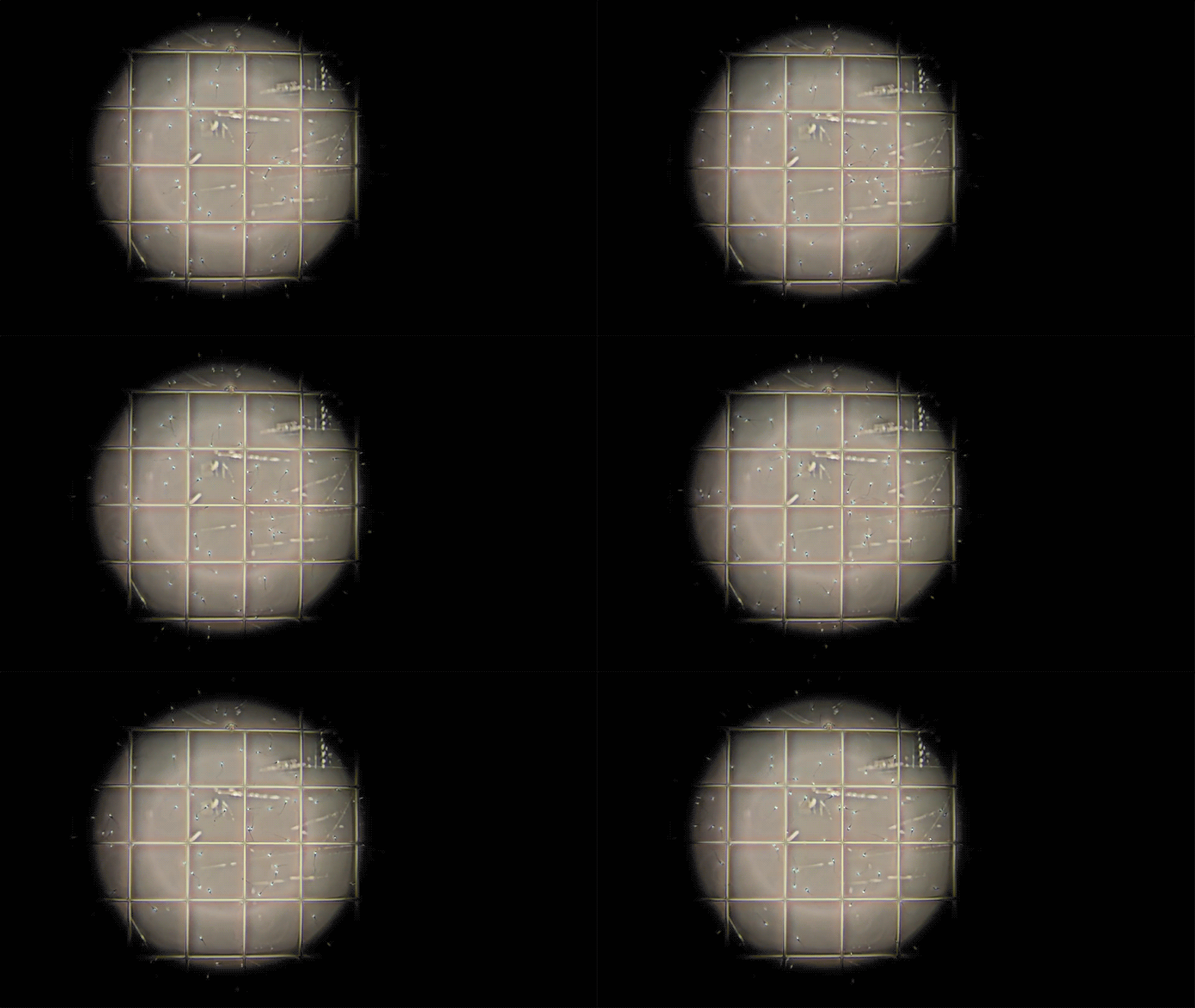 |
In this Tuesday, May 15, 2018, photo, a sperm sample is
seen through a microscope in a laboratory at Melbourne IVF in Melbourne,
Australia. (AP Photo/Wong Maye-E)
|
His mind raced. How on earth was he going to tell everyone? How would
he break it to his two grown daughters? And how could this person even
know who he was? He had been promised that his donation would be
anonymous.
And for decades it was, until a new law in one Australian state
retroactively erased the anonymity of sperm and egg donors. Their
offspring now have the legal right to know who they are.
Which is why a week after receiving that letter, Peacock found
himself staring at a photograph of a woman named Gypsy Diamond, whose
face looked so much like his own that he felt an instant and
overwhelming connection. He gazed in wonder at her dark, almond-shaped
eyes. His eyes.
“God almighty, I looked at it and I thought — ‘Bloody hell. I can’t
deny that girl,’” he says. “She was my child from the start.”
___
The walls of VARTA’s offices in downtown Melbourne are covered in
jigsaw puzzle-shaped notes bearing the hopes of donor-conceived children
and the people who helped bring them into the world: “No more secrets.”
″May you find your truth.”
VARTA is at the epicenter of Victoria state’s donor identity law, a
piece of legislation dissected and debated for years before finally
taking effect in 2017. The agency maintains a register of donors,
offspring and their parents, and counsels them through the intricate
dynamics involved.
Behind it all was a quest for the truth by people whose lives began
in a lab in an era where the sperm and egg donation industry was swathed
in secrecy.
The result, for some of those children, was a deep desire to complete
the puzzle of their identity. One Australian woman, Kerri Favarato,
says the yearning she felt to find her donor was best captured by a
Welsh word, “hiraeth.” It means, loosely, a homesickness for a place you
may have never been, a longing for something you never had.
“It’s that sense within you,” she says, “that there is something missing.”
Recognition of the rights of these children has grown, much like the
generally accepted view that adopted children should have the right to
know their birth parents. Some countries, including Australia, have now
banned anonymous donation. But Victoria is only the second jurisdiction
in the world to impose a law retroactively stripping away anonymity
without the donor’s consent.
Switzerland was the first to do so in 2001,
but many donor records were destroyed.
The other side, of course, is the missing puzzle pieces themselves:
the 2,000-or-so donors who were assured anonymity. Under the law, donors
do have the right to demand that their offspring not contact them.
Anyone who violates a contact veto can be fined 7,900 Australian dollars
($6,000).
For some, the law sparked fury.
Ian Morrison donated sperm in 1976 on the condition that he remain
anonymous. That now-broken promise angers him; he has always believed a
contract is a contract. Beyond that, though, he worries about whether
the children seeking their donors have considered the potential grief
for the people who raised them.
“If they’re expecting to get two big happy families, that ain’t going
to happen,” he says. “Life’s not like that. It’s not all going to end
up a happy ending.”
____
The truth about Gypsy Diamond’s origins unraveled on the day of her grandfather’s funeral.
Her parents were separating, and emotions were raw. Diamond, then 21,
was standing in the kitchen with her mother, Sue, when the words
tumbled out. “I need to tell you something,” Sue said abruptly. “Your
dad is not your biological father.”
Diamond fell back, stunned. Had there been a scandal? she asked. No, Sue replied. There had been a sperm donor.
Diamond was devastated. Nothing in her happy upbringing along
Victoria’s beaches had ever seemed amiss. She adored her dad. Now, she
was hearing a stranger’s sperm had been used to conceive both her and
her brother.
For awhile, she struggled to reconcile the information with who she
was. The curiosity about her heritage gnawed at her, particularly after
she gave birth to her two sons and found herself wishing for more of her
family medical history. She filled out forms requesting any details
that might be out there, but little information was legally available to
her.
That all began to change with the lobbying of a donor-conceived woman
named Narelle Grech. At 28, Grech was diagnosed with advanced bowel
cancer, likely hereditary. Grech found out from available records that
another eight children had been created from her donor. She was
determined to know the man who gave her life before her death, and to
warn him and any offspring about the gene they may be carrying.
Her fight took her to the state government’s law reform committee in
2011, where her wrenching testimony moved lawmakers to tears.
“It’s really important to me now that I can know who my paternal
family is,” Grech told the committee. “I want to be able to say that I
truly know myself before I die.”
 |
In this Wednesday, May 16, 2018, photo, Peter Peacock
feeds a wild kookaburra on the balcony of his home in Melbourne,
Australia. Peacock, who donated sperm anonymously around 1980, was
recently contacted by Gypsy Diamond, his biological daughter, after a
new law in Australia retroactively removed the anonymity granted to
sperm donors decades ago. (AP Photo/Wong Maye-E)
|
All five committee members initially opposed the law. Every member
ultimately changed their mind. Then-committee chair Clem Newton-Brown
says he came to see the donor-conceived as the forgotten byproduct of a
scientific experiment in which the joy of a new life had eclipsed a
hidden cost.
Grech would probably die long before the law passed parliament. So
the state premier intervened, and the name of Grech’s donor was
released: Ray Tonna. When Tonna met Grech, he felt an immediate rush of
love.
“It was a little switch in my heart — it went on and it was just
pure, unconditional, parental love,” he says. “It just flowed out of me
toward her. I would have done anything for her on the spot, from the
moment I met her.”
She called him Papa Ray. Six weeks later, she died.
 |
In this Tuesday, May 15, 2018, photo, scientist Fabrice De
Bond opens the lid of a cryotank containing donor sperm samples in a
lab at Melbourne IVF in Melbourne, Australia. (AP Photo/Wong Maye-E)
|
Four more years would pass before the law took effect. During that
time, Diamond had received a few details about her donor from VARTA’s
register. She knew he had been born in 1949, had brown hair and hazel
eyes. But she didn’t know his name. By this point, Diamond had convinced
herself he was dead.
And then one day in April 2017, her phone rang. It was Kate Bourne, a counselor at VARTA.
“Are you sitting down?” Bourne asked. “I’ve just got off the phone to your donor.”
___
Peacock was sweating.
It had been a week since the letter arrived, and now he found himself
sitting in VARTA’s office across from Bourne, anxiety coursing through
his body.
He pulled his jacket off and tried to cool down. Bourne explained
that a woman conceived with his sperm had requested, and would be given,
his name. But he had a choice as to whether he wanted contact with her.
 |
In this March 12, 2018, photo, provided by Peter Peacock,
Gypsy Diamond, left, meets her biological father Peter Peacock for the
first time in Geelong, Australia. Peacock donated sperm anonymously
nearly 40 years ago and was told that his offspring would never know his
identity. A new state law retroactively erasing the anonymity of sperm
and egg donors helped Diamond track down Peacock after a years-long
search. (Courtesy Peter Peacock via AP)
|
Peacock had no idea if saying yes would alter his peaceful existence.
Long divorced, the 68-year-old lives alone in a quiet suburb of
Melbourne, surrounded by a thick forest of gum trees. He hand-feeds the
wild kookaburras that fly to his porch, lovingly calling them “baby
children.”
 |
In this Thursday, May 17, 2018, photo, Peter Peacock waits
for a train as part of his hour-long journey into the city from his
home, to meet with Gypsy Diamond, 36, in Melbourne Australia. Peacock,
who donated sperm anonymously around 1980, was recently contacted by
Diamond, his biological daughter, after a new law in Australia
retroactively removed the anonymity granted to sperm donors decades ago.
(AP Photo/Wong Maye-E)
|
Eight years ago, while playing solitaire, he suffered a stroke that
gave him a fresh perspective on life. When things go awry, he now looks
for the silver linings.
His initial annoyance over the letter had given way to curiosity.
Besides, he figured this woman had the right to know her family medical
history. So he agreed to an e-mail correspondence.
Shortly after Peacock left her office, Bourne called Diamond to
deliver the news, along with her donor’s name. Bourne advised her to
take things slowly and cautioned her against Googling him right away.
“Yep,” Diamond replied as she popped Bourne on speakerphone and typed
“Peter Peacock” into Google. She found his Facebook profile and there
he was, a photo of her biological father enjoying a glass of red wine,
her own drink of choice.
 |
In this Thursday, May 17, 2018, photo, Peter Peacock is
silhouetted against sky while riding on a train into the city to meet
with Gypsy Diamond, 36. Peacock, who donated sperm anonymously around
1980, was recently contacted by Diamond, his biological daughter, after a
new law in Australia retroactively removed the anonymity granted to
sperm donors decades ago. (AP Photo/Wong Maye-E).
|
Her heart raced. She had never seen anyone who looked so much like
her. Her mother, short and blonde, was her physical antithesis. But this
man had her eyes, her coloring, a hint of her nose. She typed out a
brief email of gratitude to him, and attached two photos of herself.
Minutes later, Peacock returned home and flicked on his computer. Waiting for him was Diamond’s email.
He sat at his desk under a framed photo of Bob Dylan and felt a wave
of nostalgia. That name, Gypsy. It transported him back to his hippie
days in the ’70s, when he’d decided to donate sperm after some friends
had trouble getting pregnant. A new father himself, he became a donor in
a bid to help some couple, somewhere, have the child they’d always
wanted. He donated around eight times, received $10 a sample, and used
the money to buy a new set of power tools.
“I gave because I thought I was going to do some good somewhere,” says Peacock. “The drill was a bonus.”
Since then, he hadn’t thought much about those donations. Now the result was grinning up at him from a photo.
Peacock quickly typed out a reply. His opening line began, appropriately, “OMG.”
___
The warmth between them was instant. Their similarities went beyond
looks. Both love Shiraz and antipasto, cheer for the same football team,
and have laid-back attitudes and a cheeky sense of humor.
“Safe to say the apple has not fallen far from the tree,” Diamond
wrote. “I can see so much of yourself in me... especially the eyes. I’ve
never felt anything like it.”
He told her about his admiration for her parents, how brave they were
to accept another man’s sperm. He noted with laughter that she appeared
to have inherited his “knobbly knees.” And he asked her if Gypsy
Diamond was, in fact, her real name. She assured him it was.
“If I was going to make one up to contact my donor,” she wrote, “I probably wouldn’t choose one that sounded like a porn star.”
They both constantly checked their inboxes for new messages from each
other. Diamond often caught herself walking around with a smile.
“This has been a total whirlwind for both of us I know,” she wrote.
“But even if this never goes any further I really feel like a piece of
the puzzle that had been missing in my life has been filled and I can’t
thank you enough for that.”
 |
In this Thursday, May 17, 2018, photo, Peter Peacock, 68,
right, embraces Gypsy Diamond, 36, in Melbourne, Australia. Peacock, who
donated sperm anonymously around 1980, was recently contacted by
Diamond, his biological daughter, after a new law in Australia
retroactively removed the anonymity granted to sperm donors decades ago.
(AP Photo/Wong Maye-E)
|
The intensity of their bond surprised them both. Peacock struggled to
find the right words to sign off his messages. “Sincerely” and
“faithfully” felt too formal. He tried “your friend” and “cya later
girl.”
“I didn’t know how I would feel,” he wrote. “But feel that you are a part of my life.”
 |
In this Thursday, May 17, 2018, photo, Gypsy Diamond, 36,
speaks to The Associated Press during an interview in Melbourne,
Australia. Peter Peacock, who donated sperm anonymously around 1980, was
recently contacted by Diamond, his biological daughter, after a new law
in Australia retroactively removed the anonymity granted to sperm
donors decades ago. (AP Photo/Wong Maye-E)
|
Yet how they should fit into each others’ lives remained unknown.
Peacock worried about how Diamond’s parents felt about him. Diamond
worried about how Peacock’s daughters felt about her.
“I find myself randomly looking at your pictures and the pictures of
your girls... who at the end of the day are my sisters,” Diamond wrote.
“Are they angry that I exist? Are they worried about what I want?”
 |
In this Thursday, May 17, 2018, photo, Peter Peacock, 68,
right, and Gypsy Diamond, 36, share a laugh over a glass of Shiraz each,
their favorite type of wine, in Melbourne, Australia. Peacock, who
donated sperm anonymously around 1980, was recently contacted by
Diamond, his biological daughter, after a new law in Australia
retroactively removed the anonymity granted to sperm donors decades ago.
(AP Photo/Wong Maye-E)
|
Though Peacock remembers telling his daughters about his donations
when they were teens, they had apparently thought he was kidding. The
news of Diamond’s existence, therefore, came as a shock.
His older daughter peppered Peacock with questions: Who was this woman? Was she a scammer? Was she after his money?
Reassured that there was nothing nefarious going on, she sent a
message to Diamond introducing herself. The two soon struck up a
friendly correspondence. Diamond was delighted.
Peacock’s younger daughter was less welcoming. After asking Peacock
if this was another one of his wacky jokes, she promptly shut down the
conversation. She appeared unsettled by the emergence of another
daughter who, at 36, was a year younger than she. “I’m not the youngest
anymore,” she told Peacock.
Diamond, in turn, fretted over how her father would react to her
blossoming friendship with Peacock. Her dad had been diagnosed with
early-onset Alzheimer’s, and Diamond feared the news might confuse or
upset him. She didn’t want him to think Peacock was taking his place.
She put off the conversation for months. When she finally told him,
she kept things simple and factual. To her relief, he seemed to take the
news well.
Diamond’s brother, meanwhile, had no interest in learning about
Peacock. But her mother, Sue, had long wondered about the man who had
helped her become a parent. When Diamond told her mother she had found
him, Sue felt the same emotional charge as the day her daughter
announced she was pregnant with her first child.
Staring at Peacock’s photos, Sue didn’t see a stranger.
“He was as familiar as my children,” she says. “I went, ‘Oh my god, I
know this man — absolutely know him.’ It was totally biological.”
One day, Diamond sent Peacock photos of her children and her
brother’s. She had hesitated to send the pictures, she wrote, “but these
are your other ‘grandchildren.’”
They were indeed his grandchildren, he replied. He wrangled again with how to end the email, and then took a gamble.
“have a great day my new daughter,” he wrote. “There I said it.”
___
One question still nagged at Diamond: Was Peacock also the biological father of her brother?
Her mother wasn’t certain that she had used the same donor for both
pregnancies. So Diamond asked Peacock if he could lodge a request asking
VARTA whether any other children had been created with his donations.
In August last year, his phone rang.
“Are you sitting down?” Bourne asked. He wasn’t. She continued: “There are 16.”
Peacock sat down.
The records confirmed his 16 offspring included Diamond and her
brother. That meant there were another 14 unknown adults born between
1980 and 1982 wandering around with his DNA.
Peacock began to shake. How could the clinic have justified using his
sperm so many times? He felt like some kind of breeding animal.
Moments later, Diamond called. She had just heard the news and was frantic to see if Peacock was OK.
Peacock had already cracked open a bottle of red wine. Diamond was about to do the same.
They laughed and tried to comfort each other. Peacock asked Diamond
not to tell his eldest daughter; telling his girls about Diamond had
been hard enough.
Diamond, too, was unnerved. She wondered if the other 14 were hunting
for him, and whether that made her connection with him less special.
Legally, Peacock had the right to request the identities of his
offspring. But did he really want to invite another 14 children into his
family? And if he did request their names, they would be notified. Most
children conceived from anonymous donations are never told about their
heritage, and Peacock couldn’t imagine dropping such a bomb on them.
Despite the surprises unleashed by the law, most of the responses
from donors and their offspring have been positive, says Louise Johnson,
VARTA’s CEO. Around 80 people have applied for the identities of their
donors since the law went into effect, and the majority of donors have
agreed to exchange information. No one has broken a contact veto.
Thirty donors have requested the identities of their biological
children, Johnson says. Some of those children were stunned to find out
the truth about their origins, but later agreed to exchange information
with their donors.
Others have been less accommodating. Paul, a sperm donor who asked
that his last name be withheld for family reasons, spent decades
wondering about the fate of his biological children. And so he requested
their names.
None of his four offspring knew they were donor-conceived. One agreed
to meet him. But two were livid and wanted nothing to do with him.
Another sent a few cursory emails, then vanished from his life.
“They were given a hell of a jolt to be told that the people that
loved them the most and told them to tell the truth all their life had
forced them to live the biggest lie of all: ’We’re your parents,’” Paul
says. “They’re hating me because I’ve revealed the truth.”
___
Nearly a year after Diamond’s first email to Peacock, they had yet to
meet. They lived hours apart. And both had been rattled by the
revelation of the other 14 children.
Peacock decided that if any of his offspring come looking for him, he
will welcome them into his life. But he won’t seek them out. Their
family secrets are not his to tell.
For awhile, Diamond searched the faces of 30-somethings she passed on
the street, looking for any hint that they might be one of her
half-siblings. But she has put that behind her. Peacock has completed
her puzzle.
Still, both were jittery over the prospect of finally meeting face to face. What would seeing each other be like?
One day in March, they found out.
Peacock told Diamond he was planning to drive his red MG to a car
show near her town. He told her to search for the good-looking bloke
with the red and white umbrella. She could size him up from a distance,
he said. If she walked on by, no hard feelings.
The morning dawned hot and sunny. Peacock fussed over what to wear,
wanting to look his best. He opted for a striped, collared t-shirt and
shorts. Then he hopped in his car and headed west.
He wondered what they would talk about. He wondered whether she would even show up.
By the time Diamond arrived with her husband and sons, she was
verging on panic. Heart pounding, she jumped out of the car and went
hunting for Peacock.
She spotted the umbrella first, and then Peacock, sitting in a folding chair, reading a magazine.
She tiptoed around him once. Then, steeling herself, she made a beeline.
Peacock looked up and saw her. He grinned. She grinned back. They swept each other into a hug.
The tension leached from Diamond’s body. Peacock’s own nervousness somehow soothed her.
They looked at each other for a little while, dumbfounded, then began
chatting like old chums. “You want a drink?” Peacock asked, beckoning
her to the trunk of his car, where he’d smuggled in a thermos of Shiraz.
They settled down to talk. It all felt so natural.
Diamond’s husband eventually joined them, along with her sons.
She didn’t tell her children who Peacock was, and introduced him only as “Pete.” At 8 and 5, they are too young to understand.
But for her, Peacock is family, even if she can’t define his role.
“I know that he’s just going to be a big part of my life,” she says.
“Where it goes from there, I don’t know. I don’t really have a name for
it.”
Peacock still wrestles with how he should feel. He has such love for
this woman he was never supposed to know. Yet he is wary of overstepping
boundaries.
“Her father is the one who brought her up, loved her, changed her
nappy,” he says. “I’m not her father, I’m not her uncle, but I’m still
part of her. ... She is a part of me.”
Sitting with her at a cafe, he looks at her and wonders: Who am I to you? Who are you to me?
He raises a toast: “Cheers ... Girl? Daughter? It?”
“Whatever it is,” Diamond says with a laugh. And they drink.
